COLÉGIO SANTA CRUZ
ENSINO FUNDAMENTAL 1
SANTA CRUZ SCHOOL
PRIMARY SCHOOL 1

A Congrégation de Sainte Croix veio do Canadá para o Brasil em 1952. Fundou o Colégio Santa Cruz, cuja primeira sede ficava no bairro central de Higienópolis, mas que logo mudou para um terreno de várzea de 50.000 metros quadrados, quase na margem do Rio Pinheiros, onde está implantado até hoje.
Em 2007 fomos chamados pelo Colégio para elaborar um Plano Diretor que abrangia todos os cursos em todo o campus, plano descrito neste site.
A organização espacial do Ensino Fundamental, definida pelo Plano Diretor, previa a construção de dois grupos de prédios, destinados respectivamente ao Ensino Fundamental I e Ensino Fundamental II, interligados por um prédio existente (Edifício Irmão André) que abrigaria as salas de aula especiais (música, laboratórios de ciências, artes, etc.).
O primeiro grupo a ser edificado foi o EF I.
Escolhemos uma implantação com duas alas de dois pavimentos para as salas de aula, maximizando assim a iluminação natural. As duas alas são separadas por um grande jardim central com árvores da espécie Pau-ferro, escolha feita em função da sua copa alta que filtra o sol da tarde.
Os 2 pátios cobertos que abrigam as atividades de recreio, educação física e alimentação ficam entre as salas de aula e o resto do campus. Deles saem a passarela que interliga o prédio com as salas especiais (Edifício Irmão André) e o Ensino Fundamental II.
Os corredores foram projetados para que os professores possam utilizá-los para aulas. Esta extensão é favorecida pelas portas do fundo de cada sala de aula, que favorecem a ventilação e impedem a transmissão do som nas salas em “vis-à-vis”, onde se abrem em alternância frente-fundo.
A utilização de ar-condicionado foi necessária para atingir as temperaturas desejadas, porém a sua utilização é minimizada graças à boa inércia térmica do conjunto edificado, atingida através do alto isolamento térmico e acústico das paredes, pela troca de calor nas lajes de concreto parcialmente expostas e pelo controle da luz natural. As soluções adotadas para este controle variam em função do nível e da orientação das salas: brises verticais (pavimento superior), brises horizontais (pavimento térreo) e sombreamento oferecido pela copa das árvores do jardim central. Os 2 pavimentos se diferenciam pela orientação das suas janelas, pela colorimetria e pelo pé-direito e formato do teto.
A cobertura do pátio superior (refeitório / recreio / eventos) foi desenhada para maximizar a ventilação natural e proteger contra as chuvas fortes de verão.
No pavimento térreo, essa proteção se dá pelas marquises e pelo pé-direito mais baixo nas laterais, graças ao rebaixamento da quadra de esportes.
O curto prazo para a obra definiu a escolha de um sistema construtivo de estrutura metálica, lajes e fachadas pré-fabricadas e paredes internas em gesso acartonado.
NOTE ABOUT OUR TRANSLATION OF THE BRAZILIAN EDUCATIONAL SYSTEM
At the time we worked on this project, the Brazilian educational system was organized as such:
Children up to the age of 5 belonged to “educação infantil” which we translated as “kindergarten”
Children who were 6,7,8,9 and 10 years old belonged to the “ensino fundamental I” which we translated as “primary school I”.
Children who were 11,12, 13 and 14 years old belonged to the “ensino fundamental II” which we translated as “primary school II”.
Children who were 15, 16 and 17 years old belonged to the “ensino médio” which we translated as “high school”.
The Congrégation de Sainte Croix came from Canada to Brazil in 1952. It founded Santa Cruz School, whose first headquarters was settled in the central neighborhood of Higienópolis, but soon moved to a lowland site of 50.000 square meters at Pinheiros’ river bank, where it is until today.
In 2007 we were hired by the School to develop a Master Plan that would encompass all courses and all of the campus, which can be found in this website.
The Primary School’s spatial organization, defined by the Master Plan, foresaw the construction of two groups of buildings, destined respectively to the Primary School I and Primary School II, connected by an existing building (Brother André Building), which housed the special activities classes (music, labs, arts, etc.).
The first to be built was PS I.
We chose a site plan of two wings and two floors each for the classrooms, maximizing natural lighting. Both wings are separated by a large central garden, home to trees of the Caesalpinia ferrea species, a choice made due to its high crown, which filters the afternoon light.
The covered patios hold recess activities, physical education and the dining hall, and are placed between the classrooms and the remaining campus. From them, a footbridge connects the building to the special rooms (Brother André Building) and to PS II.
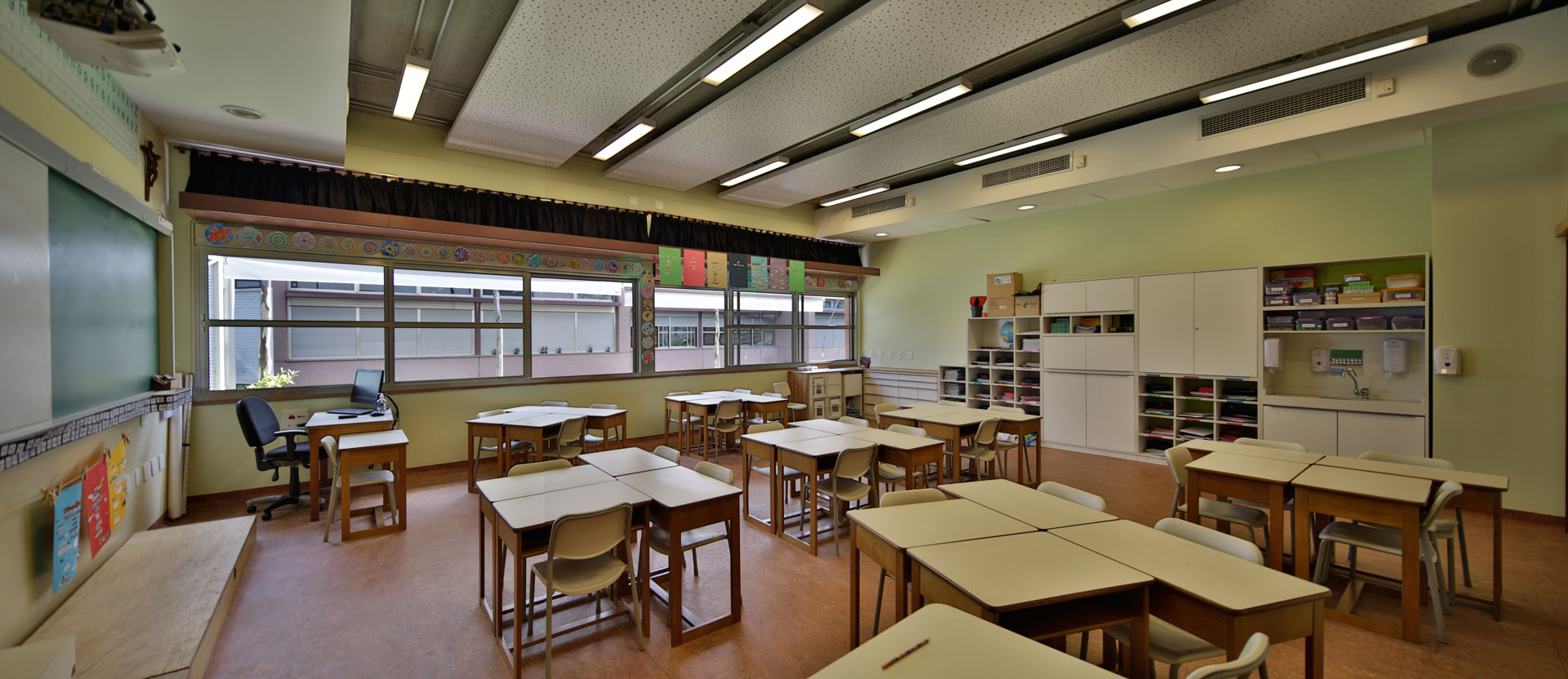
The hallways were designed so that the teachers could use them for classes. This extension is favored by the back doors in every classroom, which also help with ventilation and prevent noise transmission in the rooms vis-à-vis, by opening alternately in the front and back.
The use of air-conditioning was necessary to reach the desired temperatures; however, this use is minimized thanks to the good thermal inertia of the building, made possible by the wall’s high thermal insulation, by the heat exchange in the partially exposed concrete ceiling slabs and by controlling natural lighting. The chosen solutions for this control vary according to the room’s level and orientation: vertical brises (top floor), horizontal brises (ground floor), and the shadowing offered by the trees. The floors differ when it comes to window orientation, colorimetry, ceiling height and ceiling shape.
The first floor patio (dining hall / recess / events) was designed to maximize natural ventilation and to protect against the heavy summer rain. On the ground floor, this protection is guaranteed by the marquees and lower ceiling heights on the sides, thanks to lowering the sports court.
The short deadline for the construction work defined the choice for metallic structure, pre-fabricated slabs and façades, and internal use of drywall.




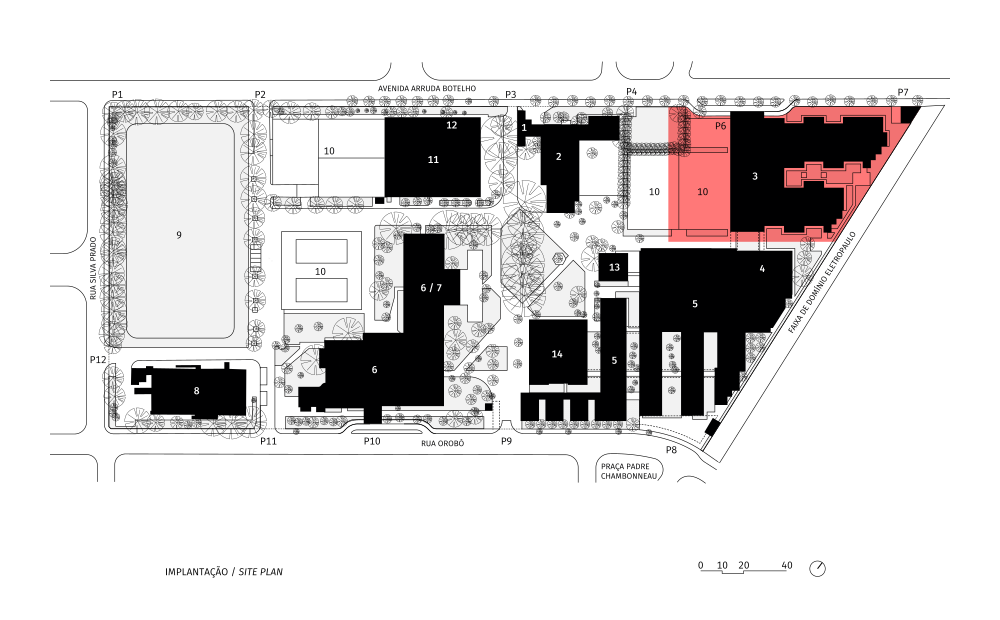
1. portaria principal / main entrance
2. educação infantil / kindergarten
3. ensino fundamental 1/ primary school 1
4. salas especiais EF1, EF2 / special classrooms PS1, PS2
5. ensino fundamental 2 / primary school 2
6. ensino médio / secondary school
7. administração central / central administration
8. teatro / theater
9. campo de futebol / soccer field
10. quadras descobertas / outdoor courts
11. ginásio de esportes / gymnasium
12. manutenção / maintenance
13. capela / chapel
14. biblioteca / library
P. portaria 1 à 12 / entrance 1 to 12
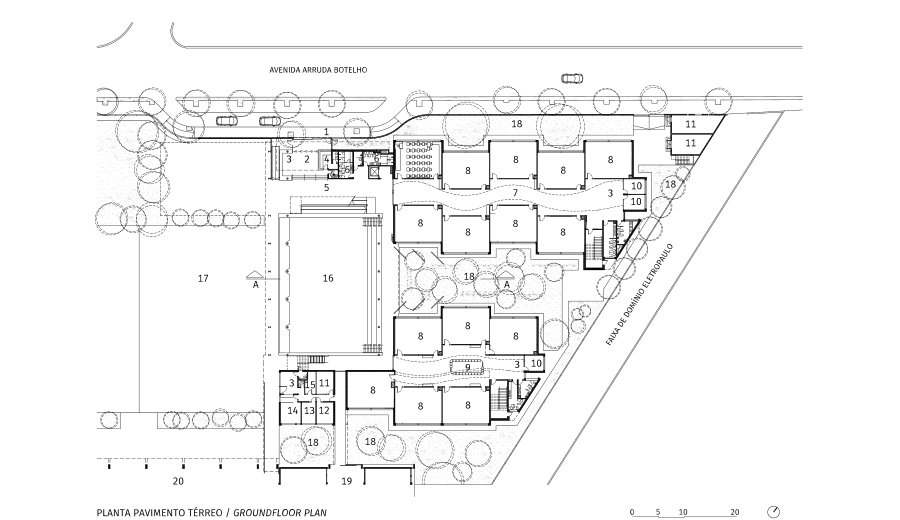
1. embarque e desembarque / boarding and deboarding
2. acolhimento / welcoming
3. espera / waiting
4. guarita / sentry house
5. pátio de entrada / entry patio
6. vestiário / locker rooms
7. hall interno / corridor
8. sala de aula / classroom
9. biblioteca / library
10. orientação / guidance
11. área técnica / technical area
12. diretoria / principal office
13. vice-diretoria / vice-principal office
14. secretaria / secretary
15. depósito / storage
16. miniginásio / small gymnasium
17. quadra descoberta / outside court
18. jardim / garden
19. edifício Irmão André / brother André building
20. EF 2 - pátio coberto / PS 2 - indoor patio

1. hall interno / corridor
2. sala de aula / classroom
3. espera / waiting
4. orientação / guidance
5. buffet / buffet
6. lanchonete / cafeteria
7. cozinha / kitchen
8. despensa / pantry
9. pátio recreio / recess patio
10. sala dos professores / teacher's lounge
11. ambulatório / first aid
12. gerador / generator
13. edifício Irmão André / bother André building

1. corredor / corridor
2. quadra / court
3. pátio recreio / recess patio
4. jardim / garden

São Paulo, SP, Brasil
2010 / 2012
Nova edificação para o Ensino Fundamental I
Congregação da Santa Cruz
5.744m²
Concluído
Arquitetura
Aki Dado Arquitetura
Colaboradores
Pablo Esperandio, Jean-Bruno Morissette,
Lorena Quiroga, Maíra Bauherz
Projeto Legal
Soluções Consultoria
Projeto Estrutural
Cia de Projetos
Projetos de Hidráulica e Elétrica
GERA Engenharia
Projeto de Ar-Condicionado e Exaustão
Willem Scheepmaker e Associados
Paisagismo
Raul Pereira Arquitetos Associados
Projetos de Luminotécnica, Acústica e
Conforto Ambiental
K2 Arquitetura
Colorimetria
João Carlos de Oliveira Cesar
Projeto de Acessibilidade
Soluções Consultoria
Engenharia Civil
RD Engenharia
Fotografia
Gal Oppido


